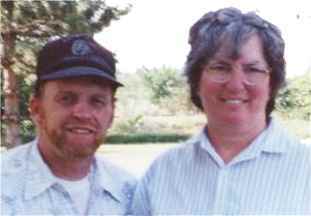
 Gara
(Yeoman) Williams,
wife of Larry Charles Williams(15) (whose
ancestry is: Armin Williams(14), Ethel Evangeline (Bowlsby) Williams(13),
John Franklin Bowlsby(12), Manuel Parkhill Bowlsby(11), Joseph I. Bowlsby(10)
Samuel Bowl(s)by(9), Samuel Bowl(s)by(8), John(7), Thomas(6), Bryan(5),
Richard(4), John(3), John(2), Rychard(1) ) has shared with us this
*wonderful* collection of poetry written and published in the 1930's by
Ethel Evangeline (Bowlsby) Williams (13).
Gara
(Yeoman) Williams,
wife of Larry Charles Williams(15) (whose
ancestry is: Armin Williams(14), Ethel Evangeline (Bowlsby) Williams(13),
John Franklin Bowlsby(12), Manuel Parkhill Bowlsby(11), Joseph I. Bowlsby(10)
Samuel Bowl(s)by(9), Samuel Bowl(s)by(8), John(7), Thomas(6), Bryan(5),
Richard(4), John(3), John(2), Rychard(1) ) has shared with us this
*wonderful* collection of poetry written and published in the 1930's by
Ethel Evangeline (Bowlsby) Williams (13).
Gara's loving comments and memories (in blue) introduce some these lovely poems. We hope you enjoy these as much as we have! (Thank you very much Gara!)
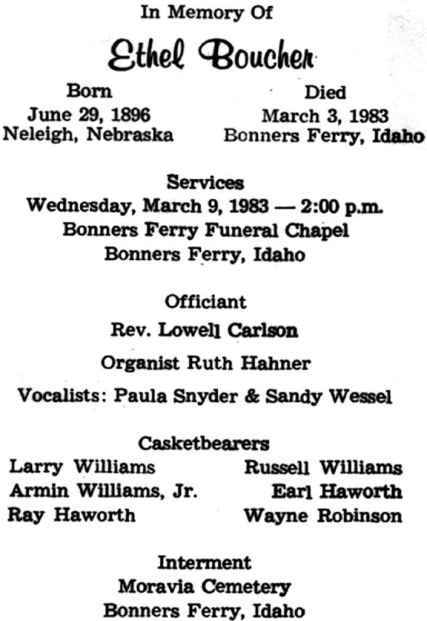
Please view a terrific article, Pioneer Profiles, published on this site with permission from the Bonner's Ferry Herald.
Montana in Verse
Ethel Evangeline Bowlsby was a small child when she came across many states in a covered wagon. Havre, Montant is pronounced "have her" only say it fast. Some mispronouce it as "havee ree". My husband Larry has an heirloom of hers that came across the praries in the covered wagon.
TO THE PIONEERS
A work that took them years,
They strove to make this State our home
These early pioneers.
Esteemed they are,
these hardy men,
These women now so
few,
Who braved the hardships
of the west,
This country vast
and new.
They are our fathers,
mothers too,
And since an early
date,
They've dearly loved
these hills and plains
In old Montana State.
In honor of thes settlers
old,
My sons and brothers
three,
I dedicate this book
of poems,
That they'll remember
me.
Montana
is considered by many as being desolate, but I loved it. I was born
and raised in San Bernardino, California until I joined the Army and was
stationed at For Lewis, WA. I met Larry there, married him in Tacoma
and he took me to his homeland, archery hunting on the Montana praries
for our honeymoon. We met up with his parents and three brothers
as we all camped in tents. It was all very exciting for me.
Camping was not new to me, however, hunting deer and elk was new to me.
After our weeklong honeymoon was up, we returned to base in Washington.
MONTANA
It's felt as well as seen,
And the landscape in the sunset
Is neither brown nor green.
An artist with his
brushes
Views with his easel
set
Cannot portray the
beauty
His feasting eyes
have met.
It seems to be elusive
As the distant shaded
blue
That clothes the rugged
mountains,
And makes them soft
to view.
When in the heat of
summer,
The many colors blend
In soft dull harmonies
of shades
As the day draws to
an end.
But the gladdest change
that comes
In Nature's changing
ways,
Is the fresh clean
mantle clothing all
That follows rainy
days.
A SUMMER BREEZE
Spread out fleecy arms to a breeze glided by.
They played many hours in the gardens of space
Till the moon peeked out with a round shining
face.
Then the weak little cloud sank softly to rest
Where the peaks of the mountains rose high in the
west.
And the breeze stole down to the whipering trees
And signed through the branches and hummed on
the seas.
It teased and it teased the sky birds of the night,
It ruffled their feathers as they rose up in flight;
A soft breath of fragrance in kindness you bring,
How tender you are when the evening bells ring.
THE OUTLAW, "SMOKY IKE"
As the wranglers brought the horses in,
But what cared we, of the Tumbling "D"
As long as the bunch was there to see
The tameing of "Smoky Ike."
The outlaw swuealed
and rolled his eyes,
Plunged ahead, then
snorts and shies,
As mid the suns first
glare, a rope cuts the air,
And a cow boy caught
that outlaw there;
The outlaw, "Smoky
Ike."
The fight was sudden,
the moment tense,
And some of the cow
boys crawled the fence-
The panting boys,
mid dust and noise
With scramble and
mirth and dirt, enjoys
The saddling of "Smoky
Ike."
A rider mounts and
sails away
On a twisting, plunging,
grunting gray;
As they cam back in
sight they finish the fight;
Hurrah, for the cow
boy sitting tight
On the deck of "Smoky
Ike."
After Larry and I got out of the Army we went and retrieved my things still at home in California and I lived in Montana for fifteen years before moving to Wilber, Nebraska, where we presently live. While in Montana, we lived 20 miles west of Havre in a small town called Kremlin. Our boys went to the Kremlin-Gildford schools and the high school in Gildford was a total of 37 students attending. Our boys graduated high school in Wilber, NE.
Beaver
Creek Park is very beautiful. It has an upper and lower lake in the
park and Beaver Creek runs through both of them. We all used to go
there often to fish and hunt whitetail deer. No hunting in the park,
however. In the fall, you look out across the prairie and you see
pink grass. I couldn't get over it when I first saw it. PINK
GRASS! Oh, I have such fond memories of Montana!
CAMPIN' ON BEAVER CREEK
The prairies had no shade
So I planned to take an outing
And sought the family's aid.
We packed us up a grub
box
And worked with all
our might;
Baked cakes and killed
some chickens,
And had them cooked
by night.
We sorted lines and
fish hooks;
Found a Prince Albert
can for bait,
And when at last we
crawled in bed
My gosh, but it was
late.
And when we kicked
the covers off
And scrambled out
of bed
The chickens hadn't
left the roost
And the eastern sky
was red.
We fed the chickens,
milked the cows,
And shut the granary
door;
Harnessed horses,
ate a bit
And swept the kitchen
floor.
The wagon held a week's
supply,
Our hearts were swelled
with joy.
We were so happy I
must say
That nothing could
annoy.
We climbed aboard behind
a team
That "felt an urge
to go,"
And settled down to
traveling
That wasn't very slow.
We made that trip of
twenty miles
With a wagon and a
team,
Out in the Bear Paw
Mountain,
And camped beside
a stream.
We ate and worked and
laughed and talked,
And waded in the creek;
And carried in some
mountain trout
Strung on a willow
stick.
The rain and hail just
soaked our beds;
And ant ot in my ear,
And Pa got mixed up
with some bees;
We howled, he looked
so queer.
Then Billie got a fever,
His face was like
a brick
That time we went
a campin'
On dear old Beaver
Creek.
When at last we started
home,
A weary bunch were
we,
But still a singing,
laughing group,
As happy as could
be.
These are memories
of Montana,
of cattle fat and
slick
Of Havre and the camping
trips
On dear old Beaver
Creek.
THE FIRE OF 1904
Of Montana's history of yore,
Is the memory of a fire,
The fire of nineteen-four.
It was in the dead
of winter,
But no snow was on
the ground
For a real chinook
was blowing
That bared the hills
around.
The town was wrapped
in slumber,
For it was one o'clock
When the startled
cry of "fire,"
Rang up and down the
block.
A dreadful cry was
"fire,"
To the early pioneer,
And when awakened
up that night
Their hearts were
cold with fear.
Thus the town was well
aroused,
Yes, every man turned
out
And volunteered to
fight the fiend
Aflaming all about.
But they were truly
handicapped
The equipment was
so poor,
But they made a mighty
effort,
Of that you may be
sure.
They attached a hose
to the power plant,
And laundry tankclose
by,
And lo, the one to
the old town pump
Without delay went
dry.
But did they need new
business men,
To take the ruins
o'er,
And thus construct
the business blocks
Where theirs had stood
before?
Well no, they planned
without delay,
And early laid their
plans,
And around those few
good buildings made
The City of Harve
stands.
So Havre, the trading
center
Was almost wiped away,
And there arose the
better buildings,
The Havre of today.
A COWBOY'S DAWN
As a crack of light in the east
Lets in a streak of morn across
A starlit dome to crease.
Man and horse they
flicker along
Mid the flickerin'
shadows around
The glory of the air
enhance like a song
They smell the sweet
dew on the ground.
There's the comely
chatter of a magpie heard,
And a prairie dog's
querulous bark,
The wee-wee twitter
of a little bird,
And the joyful song
of a lark.
The stock, the birds,
the miles of grass;
The plains roll on
to the skies;
A life in the open
is the only ties
Of a cowboy's paradise.
The lowing dogies to
the grass slopes fair
Their slick sides
shine in the sun,
For now there is a
flow in the very air
And the night is completely
done.
And thus I picture
a rosy morn,
A cowboy's day begun;
A lariat tied to the
saddle horn,
And a long horn on
the run.
"PIONEERS"
But it was the "wild west" then,
There came a little woman,
And two big brawny men.
A gruff and brawny
father,
A stubborn, scowling
son,
And just a slender
woman
With battles to be
won.
Thus came on the squatters,
And built a home of
sod,
And to relieve the
thirst of the parching
plains
They besieged a "wild
west God."
The sod was touch and
matted;
The grass roots held
like thongs;
The men were hard
and bitter,
The woman sang the
songs.
The host dry winds
in summer
Blew long on the growing
grain,
And so it turned to
stubble
For the want of a
drop of rain.
Ere long the breath
of winter
On an east wind laden
with snow
Bore down across the
prairies
With a rousting blizzard
in tow.
Then trough a long
hard winter,
All huddled by a sheet
iron stove,
Or chopping and chopping
at the cottenwoods
They cleared their
treasured grove.
Then there sprang a
chinook from the
westward
Just when the fuel
was gone,
And warmed their hearts
and bodies,
And lent courage to
struggle on.
So they deserted the
hut on the hillside,
And started to dig
a hole
To cover and use as
a dug-out,
And they struck a
vein of coal.
Yes five or six feet
from the surface,
They gazed with bated
breath,
There was tons and
tons of fuel,
And they had almost
froze to death.
So they dug and dug
and prospered,
As they never had
before;
Thus our history,
so much like fables
Of old Montant's lore.
"THE WHITE PINE MINES"
That brings a country fame
That made our history and our state,
The early settlers came.
Then sourdoughs came
drifting through,
And dug some here
and there,
Then drifted on to
other hills;
And early throughfare.
They were not hunting
gold in quartz,
Or silver, streaked
with led,
But pure gold and
silver too
They searched these
hills instead.
For many suns and many
moons
The years have drifted
on,
But the Bear Paws
bear a record
That men have come
and gone.
Then staton went to
White Pine,
And there he dug a
hole,
And found some quartz,
what did he seek?
Perhaps he hunted
coal.
Or maybe he like others,
Just thought it looked
too thin,
A losing proposition
To sink his dollars
in.
In fact he dug a hole
there,
And then released
his right,
And now that thirty
years have passed
His on is on the site.
But Williams in the
meantime,
Homesteaded on White
Pine,
And staked a couple
claims, to boot,
And has a prospect
mine.
They both are working
on a lead,
The quartz is on the
dump,
When fortune handed
out the cards
They each one drew
a trump.
These
horse stories it seems there were no such thing as a tame one. The
horses were running wild and they had roundups and breaking them to ride.
Horses to the pioneers were tools much like our automobiles are today.
The horses were not used much for pleasure riding like they are today.
And I LOVE horses and even owned our own in Montana. There names
were Lady, Flame, and Kazarro. I owned horses when I lived in California
also. Their names were Dolly and Goldie. I used my Uncle's
horse, Lucky, as a guide horse while I worked for a riding stable in California.
It gave me some weekend money as a teenager.
"PUNKIN PIE"
Now gal, don't jump so high;
Watch 'er duck,
See 'er buck,
Dont let'er sidle by.
Oh, the knots you've tied
In that pretty hide;
I've got you, "Pinkin Pie."
Draw 'er up tight to
that snubbin' post
Or know the reason
why;
See 'er mane,
Like golden grain
Down on 'er shoulder
lie;
Oh, yaller mare,
Just nort and rar'
But I'll tame you,
"Punkin Pie."
Now you are scared,
that's why you fight;
Oh, gal, you're proud
and spry;
Her teeth are bare,
Both hide and hair;
She'd eat this homely
guy,
For that rope cuts
in,
It bites like sin;
It hurts you, "punkin
Pie."
Now quiet down, I love
you, gal,
I'll teach you not
to shy;
Don't tremble so,
And strain and show
The white that's in
your eye.
She nosed me.
Fine.
She's mine, she's
mine;
My nugget, "Punkin
Pie."
TOMORROW
With the rising of the sun,
See so clearly, yet unknown
That space of time, our own;
To give us grief or joy, or leave us
At bed time, looking longingly for the morrow;
In hopes that it will bring
Something more satisfying
Than the present day has brought;
That we may maintain courage
To face and live each day
Whatever it may have to offer,
Of good or bad, for our life's education.
It matters not how insignificant
We may seem to others,
Still our very existence
Is a word or two in the history of time;
And those around us
are helped or hindered
By their contact with us,
Inspired by our neighborliness,
To be more neighborly.
Held back from doing wrong
By their regard to keep our good opinion,
Or become more loving
By a little kindness shown them.
And many times we are the ones
That are lifted up, and helped the most,
And tomorrow-always in the distance,
Like the blue of the atmosphere
That makes the distant mountains
Look soft and blue and beautiful.
These Milk River is north of Kremlin about 12 miles and it runs into Fresno Lake which is a huge lake when full. The river is now a constant controlled flow through Havre. Much different now than what it was in grandma's day.
AUGUST
Its milky waters ooze along
The path that its brink has led
A thirsty steer, so strong.
A narrow stream, a
step across,
Shallow 'neath an
August sun;
The damp sweet scent,
the rocks the moss,
To which the dust
choked critters run.
How harmless looks
the agate stream
Upon the ribbed yellow
sand,
In quivering air the
heat waves beam;
How dry, how dry the
sun baked land.
Akin to stealth the
quick sands lurk
In death holes here
and there
With cruel intent,
will ever work
And the unwary brutes
ensnare.
There's many slake
their painful thirst,
And grunt their bovine
thanks;
While other sink in
sands accursed
And never leave its
banks.
The very scenes that
welcome peace,
And give parched mouths
a drink,
That speak of comforts
ne'er to cease,
And hands that lead
us to the brink.
"CACTUS BILL"
Was a Montana whirlwind, a real cyclone;
For he'd squeal and stomp, and buck and moan,
Twist and buckle and pitch and groan;
They called him Cactus Bill.
He was wise and ugly,
and mean and stout,
And he hunted the
cactus all about;
And each crippled
rider would jerk and shout,
While the waddies
picked the stickers out
After leaving Cactus
Bill.
Every rider was broke
and sold,
For he piled them
all, both young and old,
The wild and handsome,
rough and bold,
The same old story
was always told
Of tricky Cactus Bill.
THE ROUNDUP
And a hundred old cow brutes
Are bedding down beside me here tonight,
And before the break of dawn,
I will thor my saddle on
And haze this heard of stragglers on a mite.
I must join the round
up soon,
Yes, before tomorrow
noon,
And help to shunt
these doggies to the ranch;
There is well a thousand
head;
That is what the foreman
said,
And they'll tally
more than that without a chance.
And when the roundup's
through,
We'll have a barbeque,
And we'll ride the
meanest broncs for miles around;
And the cook will
be there too,
With a pot of yearling
stew,
And the finest soda
biscuits to be found.
RANGELAND
Where the creeks in summer go dry,
And the heat waves dance and glimmer,
And the clouds sail light and high.
There herds of white-faced
cattle
Stand ankle deep in
mud,
Near a tiny willow-fringed
water hole,
And lazily chew their
cud.
They gaze on the grass
and sage brush,
And switch at the
tormenting flies
And lick their fat
sides in the sunshine;
A life that no cow
could despise.
They love the scent
of the sage,
The grass and the
cool, sweet springs,
The clean pure air
of the range lands,
And the comfort the
cool nights bring.
THE SHEEP GRAZE THROUGH
A prairie bare as a floor,
The herd moves on as a worm would creep,
And blaa, blaa, blaa some more.
The praries are cropped
of every spear
Of grass, right down
to the ground;
Rocks are scattered
ar and near
Where none before
were found.
The rocks were there
but hid from view
By a carpet of prairie
grass,
Where horses grazed,
and cattle too,
Before the woolies
passed.
A band of sheep just
grazing through,
The season's grass
crop gone,
And a bleak bare strip
of prairie too,
Forlornly greets the
dawn.
Then November's winds,
so chilly and raw,
Comes raging over
the lands,
And nosing the ground
in a shallow draw,
Comes the cows and
calves in bands.
They're gaunt and hungry
and weary and lean
While the wind never
ceases to blow
But bites right into
their very spleen,
As they swing their
heads and low.
So that's the scene
that follows
The blaa, blaa, blaa
and now
There's range cattle
bunched in the hollows,
And the low of a hungry
cow.
THE PINE
Cheery, changeless
pine,
Whose color never
fails to shine
Amid the leafless
trees, on dreary winter days.
And beckons a pulse
of hope,
To stir the leafless
slope,
To longing for their
foliage bright arrays.
So even in the winter
days
Of life, the Mays,
Stand out in bold
contrast beside
The drab that seems
to hold,
The long bare branches
to the cold,
And accept that speck
of green our guide.
Cheerful speck of green,
Adorning the dull
scene,
Greets the eye, and
charms us on to smile
So in the scenes of
life
Amid the cares and
strife
Courageous hearts
are always there to guile.
THE WADDY'S LAMENT
My race is almost run,
There's nothing left for a cow-hand
My days in the saddle are done.
I do not like to stand
about,
And hear the drifters
talk,
Or wear big blisters
on my feet,
Upon the concrete
walk.
My saddle hangs in
the harness shed
Likewise my chaps
and spurs,
Oh! how I'd love to
spread my bed
Down on the grass
and burrs.
I'm sad and lonely
most the time,
I'm sick of the noise
and mob,
I almost wish I hadn't
lived,
Beyond my cow boys
job.
THE BAD LANDS
Solid clay knolls, without the softening cloak of
grass or bush,
Stands in glimmering, shimmering hazy beauty
Of gray, brown, blue and rust;
And sheds an appealing loveliness of its own,
In a vibrant atmosphere that reaches far.
This rough landscape
holds a tender ruggedness,
And the harsh and
jagged contour of the hills
Holds nothing that
would jar, or mar the beauty of
the scene.
So thus the miles
of bad lands stretch away
To meet with prairies
vast on either hand;
Or send a crooked
canyon reaching out
To form a natural
water way between the hills.
Oh, fantastic land
along the old Missouri,
Where the sand bars
lie beside the bed
That curbs an opal,
milky stream where dwells a
living blessing.
To the thirsty creatures
seeking life in its relief;
Where the hawks and
buzzards wing a wandering
way in tactless blue,
And below, the cowboys
journey through with a
trail.
"THE COW BIRD"
Upon a white-faced cow,
It matters not how the days are spent,
Or when, or where, or how.
She lays her eggs with
the other birds,
Nor does she give
a care
About the orphan birdlings,
Nor how the wee things
fare.
Her only love it the
white-faced cow,
With her she is content,
And all the sunny
summer days
On the cows broad
back is spent.
ALONG MILK RIVER
The opaque waters sifts the sand,
The bad-lands lift their barren clay
Like hand wrought sentinels stand.
The working sands and
river soil
Have nourished willows
there,
The wild rose blooms
like shimmering voile
And scents the bouyant
air.
The cotton woods and
quaking asp
With mingled branches
stands
Like sisters hands,
in friendly clasp,
Their roots entwined
beneath the sands.
The magpies flutter
here and there
In glancing black
and white;
Their clear voiced
chatter fills the air
From early morn till
night.
A bull berry bush lifts
thorny arms
As a war lord lifts
a spear
In the distance has
a note of charm,
But wounds, if you
come near.
Or corner of the world
apart
By hills and prairies
bound;
And Havre is the pulsing
heart,
All fields and fenced
around.
Oh, clean aired west,
Oh, meadow lark,
Your song beats in
the air,
The west is just the
west, and hark
That lark is singing
there.