This wonderful letter is shared with us by Jim and Linda Sue Bowlby. Jim shares the following insites to the letter:I'm attaching a rather "colorful" letter from my Grandfather to my mother that was written during WWII shortly after my mother and father were married. My father had either shipped out or was in the process of heading to the Pacific. He was a Navy pharmacist and eventually wound up on Guam with my mother where my older brother was born. This letter was instrumental in helping our branch of the tree make a connection with the work that you and the others had already done. I'm not sure if in the telling Grandfather Tex might have skipped a generation or two but it's interesting that the family stories about coming over from England and landing in New Jersey were substantiated. Our little piece of the family tree really appreciate that effort.My grandfather was apparently big on nicknames so I wanted to give you their full names which will help in picking them out on the tree:
Johnny - Arthur Francis Bowlby, my father
Tex - Arthur Vincent Bowlby, my grandfather
Johnny's grandfather - Frank R. Bowlby
Johnny's g-grandfather - Samuel Bowlby
Johnny's g-g-grandfather - John BowlbyIf there are any descendents of my grandfather's brother William who read this letter I apologize for the disparaging remarks from Grandfather Tex. This is one of those family mysteries that we'll probably never know anything more about. Grandfather Tex kind of left us hanging without a whole lot of details. Maybe that's a good thing.
A good portion of the letter covers my maternal grandmother's side of the family. Although it doesn't have anything to do with the main Bowlby family tree it does make for some interesting reading.
When I retyped this letter I found a couple of dates that didn't seem to make sense. They are on my maternal grandmother's side so this is probably not of much interest to the rest of the group. I flagged the dates in bold and will be checking on them in the future.
I hope that this letter isn't too "colorful". I said good-bye to Grandfather Tex when I was six years old. He did make a lasting impression and I think that you'll see his personality reflected in his writing.
James (Jim) Arthur Bowlby
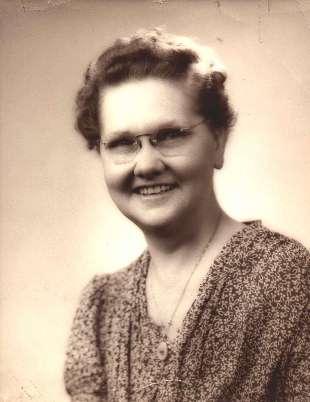
Arthur Vincent (Tex) and Ann Lena (Warren) Bowlby
Fort Worth, 3, Texas
504 West 2nd
Feb. 17, 1945Dear Mildred:
At long last that off day has caught up with me. It is Sunday and 7:30 AM. - 5:30 AM to you - and you are probably still asleep. It’s going to take up most of the morning to get this thing done, so would advise you to run around the corner and get yourself something to drink before you tackle it. I have promised to answer all your questions at once and now that I am up against it, it looks like a real job.To begin with, here’s a letter from you dated Nov. 17, 1944, asking about Johnny’s family connections and to whom should we send Xmas cards etc. The last part of that question can be answered easily and more or less abruptly. We just don’t send cards of that sort to anyone. Don’t get me wrong on this thing. We’re not mad at anybody. But years ago we reached the conclusion that a good juicy letter of our own making would be much better than a two-bit postal card with the thoughts of someone else on it. Maybe we were behind the door when the sentiment was passed out, but that’s how we feel anyhow.
We are also somewhat like that as regards the giving of presents. If we are going down the street with our hands in our pockets and our coat-tails flopping in the breeze, and we suddenly realize that we are looking at something you could use or would like to have, we get it - if we can afford it - and send same to you post haste. It never occurs to us that we should look up on the calendar when Xmas or some other anniversary is coming around, and wait until then to send it.
With kids it’s different. Xmas and all holidays, for that matter, are a kid’s paradise. We are firm believers in it. You can no more raise a child without a Santa Clause than you can raise a fish without water. Well, enough of this. Now for the first part of your question, and you’d better go have a long drink now.
To begin our history, in this country, we have only to go back to Johnny’s great-great grandfather. That old duck and his brother came here from England and got off the boat (not the Mayflower) about where New Jersey is now. They didn’t have a darn thing but their clothes, a rifle and an axe each. They struck out westward, as was the custom those days, and one of them stopped somewhere about Pennsylvania and has been lost since. The Bowlby name, however, is liberally sprinkled around over the New England states so we presume he did all right.
Johnny’s direct ancestor, being a more adventuresome soul, kept on westward to what is now Iowa. He settled near the present township of Des Moines and raised his family there. There were two boys and a girl. After the old man’s death one of the boys - Johnny’s great grandfather - also an adventuresome soul, pushed on southward into Nebraska territory and for some unaccountable reason stopped on the Great Plains between Omaha and Lincoln. I guess he like wide open spaces. Certainly that’s all there was there at that time. Anyhow, it was there that he raised his family, also two boys and a girl. And that brings us down to Johnny’s grandfather Bowlby for he was one of those boys.
All three of these young ones were adventuresome souls. They scattered like a flock of scared sage-hens. The girl, Gussie, married and went to Canada. She returned years later and finally died in Iowa at the old home place. One of the boys, Victor, just contented himself with going from one place to another for no apparent reason at all. Johnny knew both of these people, his great-aunt Gussie and his great-uncle Victor, and I think I am safe in saying that he thought a lot of Victor (Some time you should ask him about the time he and Vic put Johnny’s grandfather’s night-gown on a dog). And that gets us down to Johnny’s grandfather Bowlby.
He pushed on south as far as Galena, Kansas and it was there that I was born. There were four besides me: Frank the oldest and now living in Liberal, Kansas; Mable, the next in line, now dead and interred at Yuma, Ariz.; then came William who is, I think, still alive and doing well somewhere in your neighborhood. (If you should run into his name somewhere don’t go looking him up. If he should run into you, give him a very cold shoulder. He’s got an honest-to-God smooth line of talk, but I regret to say, he is a perfect louse.) Then came me….. Anything can, and does seem to happen. There was one other somewhere in all this, but he died of pneumonia at an early age. I’ve even forgotten his name. It was before my time anyway.
Well, to continue the story. We brats quit the nest as soon as we sprouted wings. The whole damn family is of a nomadic character. Its’ in the blood. I, being the youngest, was the last to leave home - at the ripe old age of fifteen. Shortly after I had gone, my mother and father separated and were later divorced. She, also from a line of nomads, finally wound up in Santa Barbara where she died and was buried in 1924. My father, like his sister Gussie, elected to return to their old home place in Iowa to die. He completed this simple rite the last day of 1941.
Now, we’ve got it boiled down to Johnny and me. We can rub out all the rest. My brother, Frank, sired two children, both girls. My sister, Mable, bore no children at all, and my brother, William, (the heel) sired one child, also a girl. I have sired four. The first was your Johnny, followed by three girls, all of which died shortly after birth. And that leaves Johnny the last male on his branch of the family tree.
There’s not much we can say about me. I came on to Texas from Kansas in 1917. Being too young to get in any branch of the service I went to work in the electric power producing business, and been at it ever since. I met Ann here in Ft. Worth in 1920 and we were married in Nov. of that year.
My feet, like the feet of all our clan, were itchy, and just had to go somewhere. Well, I applied for, and got, a job in a hydroelectric plant in Alabama. So in the spring of 1921 Ann and me packed our few things and took off. Going over we had more fun than any two idiots you ever saw. We busted smack into the middle of the big Mississippi and White River floods, which balled up our train schedule and caused us to have to lay over in Memphis, Tenn. All that suited us fine. We didn’t have sense enough to worry. We finally did reach our destination with our old beat-up suitcases and six dollars in cash. However, the job was waiting and we went right to work and set up housekeeping as best we could with what we had.
Then, by golly, Ann came up pregnant. She was seventeen and I was nineteen and neither of us knew nothin’ from nothin’.
I repeat, we were too dumb to worry, and looking back at it now. I am glad we were. We spent that summer doing all the things young people do. Swimming, sailing on the lake, hunting everything from mountain lions to squirrels, trudging through swamps and climbing mountains. Never a dull moment.
Nature, however, will not be denied. An so summer wore away at last, and then autumn came and went leaving us the bleak winter in southern swamps. There’s nothing funny about a winter in southern swamps. If you’ve never spent a winter in the swamps for the love of Mike, don’t.
The inevitable day of maternity came around, and then, not until then, did we begin to understand the seriousness of our situation. We had engaged a doctor - there were two of them in the county - and at his suggestion, a midwife. Ann (there’s no ‘e’ on the end of her name. Just plain Ann.) started labor about the middle of the afternoon. The midwife and doctor were called and by the time the doctor got there we were all ready for the big happening. But nothing happened.
All that afternoon and night she labored and still no soap. The brat flatly refused to be born. Along about midnight our doctor began to worry and asked me to call the other doctor. I didn’t know, but he knew that he would need help. Well, when our new doctor arrived he was tighter than a Yiddish purse string, and as the night wore on he got tighter, he had brought his bottle along with him. It was he, however, that brought the gal and her child through.
Along about 4AM Ann began slipping. She just couldn’t go any farther. It was obvious, even to me that something had to be done. Our Doctor Johnson, bless his drunken soul, started scratching around in his grips - doctors in those days carried their own drug store and hospital equipment with them - and came up with an old rusty beat-up pair of forceps the like of which I have never seen.
And so it was that in the cold drizzly dawn of Jan. 6th, 1922, thirteen miles from the nearest village and sixty miles by logging road to the nearest hospital, in a rough pine board cabin, between the lakeshore and the edge of the swamps, your Johnny was literally forced into existence. For many hours after it was a tossup if either would live. I don’t know what powers hover over a scene like that, but whatever it was, it was good to us. They lived, and in a months time both were as fat, sassy, and troublesome as if nothing had ever happened. I made and washed more diapers than Job had blisters.
I’m getting tired pounding on this thing, and you’re about worn out reading. Let’s get another drink and start over.
Ann’s side of the story, although much more colorful, is not so long and tiresome. Her grandfather was a full-blooded Delaware Indian. The first account we have of him is about the beginning of the Civil War. He simply stalked out of the woods with a rifle on his shoulder and told all within hearing there was a fight going on and where was it, he’d like to get in on it. He didn’t have long to wait because the Union was hard put for men at the time and promptly signed him on as a professional soldier. (Shame we didn’t have a worthwhile navy at that time.) The old boy was in his seventh heaven. He fought southward with Grant’s forces into Tennessee and it was there that, one night on a scouting party, he was captured by Lee’s men.
He was not one to languish in prison and his sense of patriotism must have been a bit skimpy. In fact there is no record - by word of mouth, or otherwise - that he ever tried to find out what the fight was all about in the first place. Well, the next thing we know of him he is fighting against Grant with Lee.
When the war was finally over and the smoke had blown away the old boy found himself about the state of Kansas. We have never been able to discover his original name (Indian) but somewhere, sometime, during the course of the war, he ran into, and adopted the name Warren. It was under this name that he reared his family. There were no records kept on the frontier in those days but we place his marriage at about 1840.
He sired five boys. He couldn’t stay put in one place long, so about 1858 he packed up his belongings and his family and started the long trek to Missouri. And it was in route to Missouri that Johnny’s grandfather was born.
The family didn’t take to Missouri for some reason and elected to move on.
Texas, at that time was a brand new state having been admitted to the Union in 1845 and offered possibilities. The five boys spread themselves out in this territory and took up the various vocations of the time. Needless to say, their lives were crammed full of romance and color. (Presently it will dawn on you why Johnny sometimes walks the floor and makes funny noises. As long as he feels the beat of the engines in his ship, he will be still. He’s going some place. Again, don’t get me wrong. He wants a home and a wife and maybe youngsters, but his blood is nomadic and he can’t help it. I’ve a strong feeling that he will stay in the Navy and that together you will see a very large part of our world. Mind you, I said together, he’s that kind of guy.)
Well, the Warren family pushed half way across Texas and stopped in Eastland County. They took up a land grant there on the Leon River. But the weather, along with the hardships of the times were adverse, and in 1881 the whole country out there nearly starved to death. Following that year of disaster, Johnny’s grandfather took a powder and made dust back to East Texas. He settled in Red River County and went about the business of raising his family. This he did well.
There were ten children born - six girls and four boys - but three of the girls died while young. Of the remaining seven, six are still in the state of Texas. The other, a girl, is somewhere in Calif. They, even as my own people, are of the common, hardworking, stock only there doesn’t seem to be a heel among them.
Johnny’s grandmother Warren died several years ago and the old man, whose picture I’m sending along with ours, sold his holdings and has since been living with the first one and then the other of his children.
Now to sum it all up, before I die of thirst, Johnny has living besides his mother and me, four uncles and two aunts on his mother’s side and he likes them all. Then his grandpa Warren who can’t be with us much longer. He’s seventy-eight now. On my side he has only two uncles, both of whom I’ve already told you. And now, lets get a drink and catch our breath. There’s a lot more detail to all this, but damned if I tell it now. Ain’t you glad?
I held this thing over night to mail this morning, and now I’m glad that I did. Your letter just now came in. I wish I hadn’t been so damn right when I wrote that card. It had to happen and we all knew it. We are definitely proud that your chin is still up and you leave no room to doubt that it will stay that way. Over here in Texas we say, “Just keep on keepin’ on.” And we believe in it. We like your guts. You’ve got ‘em.
Ann, after reading this thing, says my spelling is outrageous. I say it’s notorious, and that you are one of the few people who are privileged to try to puzzle out what I’m talking about.
I’ve still a lot of questions to answer but I guess I’d better write another one for them. Tell us in your next one if you write Johnny by V-mail or the regular way, and is his address the same.
Happy dreams:
Tex & Ann
Would suggest you save this and show it to Johnny. He has been told all this but in pieces. Probably has forgotten it all. No doubt believes he was laid on a stump by a crow and the sun hatched him.