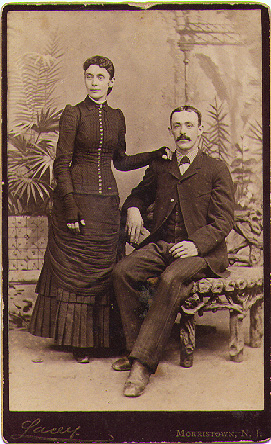
 Phebe
Eugenia (11) married Stephen H. Card and had 5 children with him:
Emma Louise (Twin) (1863-1893), Ella Nethalia (Twin) ( 1863-1914), Wilber
Ryerson (1865-1929), Minnie Eugenia (1868-1892) and Sadie Martha ( 1871-1872).
Phebe
Eugenia (11) married Stephen H. Card and had 5 children with him:
Emma Louise (Twin) (1863-1893), Ella Nethalia (Twin) ( 1863-1914), Wilber
Ryerson (1865-1929), Minnie Eugenia (1868-1892) and Sadie Martha ( 1871-1872).
The home was built in the 1790's George Bowlsby(8), son of George Bowlby
(7), son of Thomas and Martha (Barker) Bowlby (6). THE HOUSE was
passed down to Nathaniel H. Bowlsby(9). It was then passed along
to Nathaniel's daughter, Sarah Ann Bowlsby(10). Sarah Ann(10) married
Thunis Ryerson Cobb. Sarah Ann(10) and Thunis had six children, all
in generation 11: Phebe Eugenia (1843-1873), Emma Louisa (1846-1858),
Franklin Edwin (1851-1858), William Bowlsby (1857-1858), Laura E. (1859-1875)
and John B. (1864).
Emma Louise (Card) and Abraham Kimble
Phebe
Eugenia (11) married Stephen H. Card and had 5 children with him:
Emma Louise (Twin) (1863-1893), Ella Nethalia (Twin) ( 1863-1914), Wilber
Ryerson (1865-1929), Minnie Eugenia (1868-1892) and Sadie Martha ( 1871-1872).
A woman by the name of Mary Ann Cole helped Sarah Ann(10) (Bowlsby) Cobb as maid. When Sarah Ann(10) passed away, Thunis married Mary Ann Cole. Tunis and Mary Ann (Cole) Cobb had two sons: Thunis Ryerson(1860-1946) and George T. (1872-1920).
Both Thunis and his daughter Phebe(11) died within two months of one another. This left Thunis' second wife Mary Ann, and Phebe's (11) husband Stephen H., with 7 young children to care for, and an estate intestate. They must have decided they handle their challenges better together so the ex-maid and the ex-handy man married, thus saving the farm and raising the children.
This is the wonderful story about THE HOUSE and the confusing family history as told by a daughter of Stephen H. and Mary Ann Card, Mrs. Mary Ann (Card) Powell. The article is posted with the permission of Mrs. Ruth Robbins, daughter of Mrs. Powell.
We have decided to present the article almost verbatim as it came from the Card family. This includes creative spelling as well as genealogical ambiguities. However, some information about descendants who may still be living has been edited.
One point in particular does need clarification. Mary Ann (Card) Powell talks about a child of Thunis and Sarah(10) named Sadie. It will be presented in the article that after Sarah Ann(10) (Bowlsby) Cobb died, Mary Ann Cole became Sadie's stepmother. But, according to the register of births in the family Bible, this is not accurate. Sadie(12) was actually a daughter of Stephen Card and Phebe Eugenia(11). Sadie(12) died before her mother Phebe(11). The error could be in the family Bible, or it could be with Mary Ann Card Powell. "History is fiction mutually agreed upon."
Perhaps Mrs. Powell was actually thinking of Laura E.(11), a child of Sarah Ann (Bowlsby(10) and Thunis Cobb. Laura E. (11) lived through the death of her mother Sarah Ann(10) in about 1869. Mary Ann Cole became Laura E.(11)'s stepmother when she married Thunis Cobb. After Thunis died in 1873, Laura E.(11) was there to see her stepmother marry the widower of her sister, Phebe Eugenia(11). Sadly, Laura E.(11) died in 1875 at the age of 16.
This is candy to the minds of genealogists and family researchers, but probably painful for most everyone else. So, if you enjoy, and we believe you will, you must own that genealogy "gene"!
Enjoy!
Cynthia Katzman Bowlby, Andrea Cobb, and Adrian Card
THE HOUSE THE HOUSE stands on the west side of Baldwin Road, about 350 yards south of Vail Road in Parsippany, New Jersey. It was built by George Bowlsby, Jr., probably in the early 1790s. It remained the property of the Bowlsby family and their heirs until 1873, when it was sold to Stephen H. and Mary A. Card, my mother and father.
THE HOUSE is a one and one-half story frame structure with clapboard siding and a pitched roof. It has two inside chimneys, one at each gable end, and stone foundations which are upper extensions of the cellar walls. THE HOUSE faces south, with its main entrance in the center. There are "eyebrow" windows on the north and south sides of the upper half story, while the gables have one full window in each end.
Inside, the hallway runs from the front entrance to the rear door of the house. On either side of the hall are two interlocking rooms, each with separate access to the hall. The front room (the parlor) on the west has a fireplace with a simple mantel. The hall and the two west end rooms have floorboards of oak, about six inches wide, one and one quarter inches thick, with either elementary tongue-and-groove, or shiplap edges; the two east end rooms have floorboards of fairly narrow pine.
Along the east wall of the hallway, a stairway runs straight to the upper floor, the stair rail continuing to surround the stair well. The west part of the upper half story is partitioned off as an attic which also serves as a storeroom for such supplies as barrels of flour and sugar. In season, hickory nuts are strewn on the floor to dry. The east end of the upper half story has been divided into two bedrooms--the parents' room above the dining room and the girls' room over the kitchen. The area on the south side of the house, between the parents' room and the attic area, is occupied by a bedroom for the boys, and a closet. The floorboards of the second floor are, on the whole, quite wide--16 to 17 inches--and appear to be oak.
The cellar was a vital part of THE HOUSE and was easily accessible from the kitchen when supplies were needed. Under the front porch were six steps leading to an outside entrance door to the cellar. Potatoes for winter use filled a huge bin. The milk room was lined with shelves for pans of milk which were put to raise cream for making butter. Canned fruit, jams, and jellies occupied another shelf area where, also, there were crocks lined up for making the salt cucumber pickles. The five-foot sealed-off cistern under the kitchen floor furnished rain water for all purposes. The well furnished drinking water.
THE HOUSE 1906
As I reflect on THE HOUSE, I see it this way:
Just off the thoroughfare of the village road of Parsipanny, I see THE HOUSE--a typical New Jersey farmhouse, seated on a graceful knoll, with the broad, shaded lawn, the old fashioned well, and the trough at which the thirst of many a weary man and beast has been quenched. The two stately elms reach to the sky, their lofty limbs seeming to embrace and protect the humble dwelling beneath them, bringing about a feeling of warm welcome.
As we enter the broad hallway with its open staircase, we are reminded of Longfellow's "Children's Hour" as the grandfather clock standing in the corner ticks "Forever never/Never Forever." On the left is the parlor with the dear old chairs, the faded couch, and the pride of the household--the organ. Here is the portrait of father, and there the one of mother. More than one bride had taken the vows of Holy Matrimony beneath the arch of the folding doors, and from beneath the same archway had passed the bodies of dear ones wrapped in death.
The next door on the left of the hallway opens to the Guest Chamber. How honored this bed, for beneath its snowy covers have rested many "divines" who conducted the services in our church on Sunday. The "divines" were student pastors from Drew Seminary who spent weekends at THE HOUSE.
Returning to the hallway, we turn right and enter the Dining Room. Ah! the many memories of feasts, wedding breakfasts, Thanksgiving, and Christmas dinners are intermingled with the remembrance of friends, visitors, and strangers who have partaken of the bounties with which only the farmer's wife can tempt the appetite.
Now to the kitchen. Mother is here--mother, the figure of true hospitality. Every part of THE HOUSE is sacred to her. She has shared all its joys and sorrows for many years, but most hours of all were spent in the kitchen. We note the kitchen pump which draws water from the cistern, and the wood box which must be kept full at all times to feed the stoves in the dining room and parlor. It is nearing evening, and mother is looking out the north window, watching as father and the boys approach bearing buckets of milk for the creamery. Mother has a pitcher in hand which is filled from their supply, and shortly all will be seated at the kitchen table partaking of the abundant meal which mother has prepared.
MY PARENTS - 1873
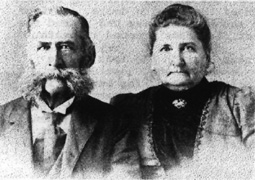
Stephen H. Card and Mary Ann ColeFollowing the deaths of Tunis Cobb and Phoebe Cobb Card in 1873, S.H. (Stephen Henry Card), the hired hand, and Mary Ann, the former maid, with their growing families shared the work of keeping up THE HOUSE and the farm. They found they had much in common to share as they tried to guide the young people into happy and useful lives.
Tunis Cobb had died intestate, and the Court decided that THE HOUSE should be sold in order to settle the estate. S.H. and Mary Ann decided that the best solution was for them to unite in marriage, buy THE HOUSE, and make a home for all six children (Sadie, the child of Tunis and Sarah had died before this time.)
Ryerson and George, the sons of Tunis and Mary Ann, and S. H. and Phoebe's four children--Emma, Ella, Wilbur, and Minnie--all were heirs to the estate. When S.H. and Mary Ann bought THE HOUSE, they decided to provide for all the children, so the four older children (the offspring of S.H. and Phoebe) were given a life right. The two Cobb boys were to be paid off when becoming of age.
On Jun 14, 1873, S.H. and Mary Ann were married. While the circumstances of the impending sale of THE HOUSE were the prime movers in their decision to marry, and though it was not a "love marriage", the years which followed brought them together with ties of deep affection and understanding.
MY MOTHER - 1850-1873
Mary Ann Cole, daughter of Mr. and Mrs. William Cole, was born May 17, 1850, the fifth of nine children. She was of direct Dutch descent. She was able to attend grade school in her early years, but when she was sixteen--in 1866-- she became a maid to Mrs. Tunis (Sarah Bowlsby) Cobb, and lived with the Cobbs in THE HOUSE. Under Mrs. Cobb's direction, she became a most efficient housekeeper.
Mrs. Cobb died in 1869, leaving a young daughter, Sadie. Tunis began to court the maid, Mary Ann, and they were soon married, so she became the mistress of THE HOUSE, and the stepmother to Sadie.
Mary Ann and Tunis had two sons from their marriage. Tunis Ryerson was born March 5, 1869, and George T. was born May 11, 1872.
Tunis Cobb was very fond of his span of carriage horses. One day he drove them to Fox Hill, where they became frightened by the local train which he had come to meet. The horses bolted and ran away, and Tunis was thrown from his seat on to the tongue of the wagon between the horses and was killed, dying just two months after the death of his young married daughter, Phoebe Card.
MY FATHER 1837 - 1873
The following unedited "memoir" was written by my father and was found after his death.
"The subject of this memoir was born March the 24, 1837 in Mount Hope, Morris Co., N.J. His parents were of English descent, fully believing in the Holy Catholic Church. S.H. Card was 4 years old when he, with three other children were left Fatherless, and we may say all most Motherless in the world, their Mother, although a kinde hearted and loveing Mother soon went in decline and in a bought two years died with that dreadful diseas knowen as consumption. S.H. and one Brother two years his Senior, and two Sisters who were younger. S.H. and Martin, the older Brother, were provided for by their Grand Parents, who took them home with them and cared for them for several years; the oldest of the Sisters, Martha J. was taken to Ohio with her uncle Samuell M. Estelle to be provided for. The youngest Sister Abbigal was taken by her uncle Stephen Hinds, to live with him at Berkshire Valley. Thus they were provided and cared for, allthough toren from each other and scattered abroad. Martin died at the age of eighteen from exposure and abuse from the hands of the demon with whom he lived.
"S.H. seemed to be the choice among the little flock and was permitted to remain with his Grand Parents who provided for him all that was needfull for his physical wants. The most important part, that which should be the first and the greatest concern, was entirely neglected in not attending to the intellectual provision, the minde. He was well drilled in every branch of farming (work), choping wood, milking cows, plowing, Harrowing, mowing by hand and in all that pertain to farming there was none that could excell.
"But he was not alowed the priveledg of going to school a day, accepting a half a day when he was permited to spend the day with his cousins and went with them to school one half a day in the Stockholm School house near Snuftown. S.H. had a very pious Grandmother who spared no pains in trying to impress upon the youthfull minde of her Grandson, the importance of seeking an interest in the preshous blood of Jesus while in his youth. She always made it a point to take him to Church and to Sabbath School allthough they had abought two mildes to walke, yet it the wether would permit at all, they were seldom absent from Church and Sabbath School. S.H. had been taught to spell and read a little by his Grand Mother and with the little aid that he got through the Sabbath School, he soon became interested in learning. His Grand Mother could not write, and therefore he was obliged to seek other aid in that branch. He succeeded in a short time in saveing change enoughch to buy him a coppy book, caled the Self taught pen men, with the aid of this book and his ambition to learn to write, he soon became a good writer. Writing seemed to be his delight. Many an hour, night and stormy days, he would spend in studying to read and write.
"Everything went smoothe for some time, until E.B.C. (Edward B. Card) the youngest son of the Grand parents became of age, then things took a far diferent aspect. S.H. was ordered abought, and kept on double quick time. If there was errands to do, S.H. was dispached, and if he staid a little too long when he returned he had to be scourged by the new master. As S.H. grew older his work was more laborious. In the summer season he was kept at work on the Farm, in them days, there were no ten housr system, it was work from daylight to dark and then S.H. was compelled to milk seven or eight cows for a play spell after a days work. It was done by hand, all the moving and raking the hay, and cradleing grane was done by hand, aand as a rule there were two stones to one of durt; which made the daly task much harder. There was no let up for S.H. when the fall work was finished, the winter work began. Choping wood and geting ought nails was the programm for the winter and if per chance there came a day when it was too storny to go to the woods, there was a good opportunity for S.H. to exercise himself at the old familiar wood pile which was kept in reserve for such occasions. We often hear boys and young men in these days lamenting their hard lot. They have to work so hard that it makes life dreary and dismal but in reality they know but comparatively little about hard work, such as was done by the youths of forty years ago. With S.H. there was nothing to break the monotony, year in and year ought it was work, work. It seemed to be the one object of E.B.C. (and here we will state this E.B.C. was an uncle of S.H.) to drill S.H. in farming and choping wood, but he was adverse to giving S.H. eney privelege of gaining any other knowledge aside from hard work.
"Many days S.H. was sent to the woods to chop wood when it was not fit for man or beast to go ought side. On one ocassion when he came home from his woods at night he pulled of his boots and found that his toes were frozen fast to his socks. He put his feet in cold water and drew ought the frost but his toes which had been frozen gave him a great deil of trouble for years after.
"At the age of 19 S.H. took his leave of his Uncle. The mane caus of his leaving was an account of a default on the part of his uncle, who pledged himself by a verble agreement to give S.H. at the age of twenty one two suits of new close, a yoke of 3 year old steers and 2 skips of beas (provided) S.H. would remain with him until he was 21 year of age but unfortunately S.H. was taken sick about 18 months before he was 21 and was under medical treatment abought three months when S.H. began to recover and was beginning to be able to commence work his Uncle informed him that as he had been sick for some time, and it had been such an expense to him, that he would not give what he had promised but that if he (S.H.) was so minded he could stay on untill he was 21 but S.H. felt that he had been trifeled with long enough and felt that it was time for him to begin to do something for him self. S.H. was now twenty years of age and had never been to school but a half a day in his life and up to this time had never been more than 10 mildes from his birth place but for his special amusement he was alowed to mow grass by hand, pick stone, chop wood, milk cows, thrash rye, plow and barrow, husk corn and all that pertain to farming in general. Being well drilled in these particular he soon found employment with a neighbor with whom he had been accquainted for some years. S.H. remained with Mr. Shauger for the best part of a year then he hired to a farmer who lived at Parsipanny, N.J. This was a great adventure as S.H. had seldom been ought of hereing of his Uncle's old cowhill. To think of going from Charlottesburg to Parsipanny, a distance of 15 miles, it was as much of an undertaking as it would be for many to start to California. It was in the Spring of 1858 that S.H. gathered to gather his little effects and his good by to his good old Grand mother who had been in reality a mother to him for 12 years. This seemed to be the most trying period of his life, to part with one so near and dear."
The following facts pertain to father's life, THE HOUSE, and these memories of his family which occupied THE HOUSE for more than thirty years:
The farmer in Parsipanny by who S.H. was employed as a farm hand was Tunis Ryerson Cobb. Mr. Cobb was married to Sarah Bowlsby, daughter of Nathaniel Bowlsby, who now lived in THE HOUSE. Tunis and Sarah had a family of growing children. S.H. joined with them in Husking Bees, Taffy Pulls, Church and Sabbath School. With young folk nearer his age, S.H. could share his limited knowledge of books and increase his limited education.
S.H. and Phoebe, the charming daughter of Tunis and Sarah Cobb, became close friends and soon thought in terms of marriage. Tunis was much opposed to his daughter marrying the hired hand. In fact, he objected so firmly that S.H. and Phoebe made their decision for themselves and were married in 1861. They lived in a small house near THE HOUSE. Phoebe soon give birth to twin girls--Emma and Ella-- in 1861. Two other children were born to them: Wilbur in 1865 and Minnie in 1867. Phoebe's health declined after that and she died in 1873.
Coincidentally, Phoebe's father, Tunis Cobb, died just two months following Phoebe's death.
COMPLICATED FAMILY
I am my mother's daughter and step-granddaughter.
My mother married Tunis Cobb. My father married Tunis Cobb's daughter. This made my mother the stepmother-in-law to my father.
Mother became step-grandmother to father's children and father became half-step-brother to mother's children. Mother's sons became uncles to father's children.
Tunis Cobb and his daughter both died. Mother and Father then married. This made another complication. Their children became half-sisters and half-brothers but when I was born I became the daughter and step-granddaughter to my mother and a daughter and half-step-sister to my father.
MARY ANN CARD POWELL 1880-
The marriage of S.H. and Mary Ann resulted in the birth of seven children, all of whom but one survived to live full lives. Serena was born in 1874, Harry in 1876, Ida in 1878, Mary Ann in 1880, Andrews Bowlsby in 1882, Melvin Cleveland in 1884, and Edith in 1886.
I was born on April 20, 1880, and was named for my mother, Mary Ann. I have many memories of THE HOUSE, which was my home until I was wed in 1903. One of my very first memories was of the winter when I was nearly four years old. During that year my father had a sale of various items (a cow, a piece of machinery, etc.) to raise the money to pay the mortgage. Farmers from the area would come in and out of the house all day as they came to trade. Because of the draftiness caused by the opening of the doors, the baby, Melvin Cleveland, developed a cold which turned to pneumonia, and the child died. The baby's body was not taken to the funeral parlor, but left at home. It was dressed and laid on the ironing board. I recall that mother had me in her arms on the way up stairs to bed when she entered the room where the baby had been prepared, removed the cover from the lifeless form, and bid it good night.
When I was five and a half years old, I started in public school. With lunch box in hand, I walked one and a half miles to the one-room, six-grade schoolhouse at Troy Hills. I recall that at recess time one of the older boys would go to a nearby house and bring back a pail of drinking water. He would dip water from the pail, and the dipper would be passed from one child to another, as each child drank from the same dipper. I remember always sipping as close to the handle as possible, so my lips would find an untouched spot.
Another vivid memory is of the Blizzard of 1888. I was eight years old. It was Sunday, and as was quite usual, THE HOUSE was the host to the seminary student who arrived each Saturday evening to stay overnight and to be on hand to lead the Sunday service in our church. In addition to the regular household members and the hired hand, the young man who was courting half-sister Minnie was present, as were Wilbur and his young wife.
As dinner time, as we sat around the table, the snow had not yet started. It began to storm in the afternoon and rapidly worsened to such an extent that no one dared leave THE HOUSE to go home. As evening closed in it was evident that there was to be no let-up, so mother hustled about seeing how she could provide sleeping room for everyone. She put the seminarian and Minnie's young friend together in the Guest Chamber. The married couple were put into the boys' bedroom, and the girls went to their own room. The boys and the hired man took their bedding to the barn and slept in the hay mound.
Awakening on Monday morning, we found the drifts so high--up to the eaves of the barn roof--that we couldn't get the cows out. The men shoveled to the barn, and then carried buckets of water to the cows and horses. Each farmer shoveled a path from his farm to the road, and then each farmer would open up the road from his property to that of the next farm. The drifts were often six feet high, and the shoveled snow had to be thrown over that height.
While the men were occupied with the digging out and the care of the animals, mother called on the stores of ham, bacon, spare ribs, vegetables, and fruits to prepare the meals needed to take care of the enlarged family which occupied THE HOUSE.
When I was ready for the sixth grade, I went to Boonton, N.J. to live with my half-sister Minnie, and Minnie's husband Dick. This was a grade school with a teacher for each grade, and I continued here until I was ready for High School. After one year at high school, I returned to THE HOUSE and became a seamstress. Church and Sabbath School were the main social life, and it was here I met romance.
In the 1890s, the officers and friends of the Little White Church on the hill decided to built a parsonage where a married student could live with this wife, and, in addition to weekends, could spend any other time when he did not need to be at the (Drew) Seminary. So the Guest Chamber at THE HOUSE was no longer used by the student pastor.
The student pastor, Harvey Templin, and his wife were occupants of the parsonage. Mr. Templin was interested in the growth of the church community and planned a series of special meetings to help reach this goal. He invited an evangelistic student, Felix Powell, to help him, and Felix proved to be a talented speaker and singer.
It was at these meetings that I met Felix, we were mutually attracted to each other, and after about a year's courtship, we were married on May 13, 1903.
Felix had been appointed to a small island church in Casco Bay, Portland, Main, so we left to begin our new life together, but never would I lose the many memories of THE HOUSE which had been my home for 23 years.
Our only son, Alger, was born there February 26, 1905. Alger is retired and with his wife, Dorothy, ... have three sons. Alger was awarded the "Distinguished Citizen of the Year Award" by the North Haven Jaycees at their Fifth Annual Awards Banquet in January 1976.
Esther was born on Long Island February 27, 1907. She is widowed and retired from the Boston University School of Theology.
In 1907 we were transferred to Berlin, New Hampshire, where we served seven years.
Virginia was born there August 26, 1908. She and her husband, Rev. Ellis J. Holt, are retired and ... have four sons.
Ruth, too, is a New Hampshire native, born October 19, 1910. She and her husband, Robert M. Robbins, Jr., ... have two daughters.
Our third pastorate was South Portland, Maine. Here, again, we were blessed with two babies:
Eva was born December 28, 1915. She is widowed and lives in her own home...
Frances was born December 4, 1918. She, with her husband Maurice Caron...have two children.
After serving three years in South Portland, Felix was appointed Maine Conference Evangelist. We then bought a home in South Portland where we lived ten years. Felix traveled much of the time and I began investing in my family of six growing children. Since my widowhood, my "home" address is with Ruth and Bob in Connecticut, where my church membership is maintained at Faith United Methodist Church of North Haven; my summer months are with Virginia and "Sam" in Maine, and my winter months with Eva in Florida. In the spring and fall I enjoy time with the others. Each July 4th we have a "Powell" family picnic when forty or more usually come, and often we have one newly-born member join us! This leads me to enumerate: I have 6 children, 13 grandchildren, 28 great-grandchildren, and 3 great, great grandchildren!
Over the years I have been privileged to travel to some extent--across the waters to England with Virginia, four trips to the West Coast to conventions with Gin and Sam: Denver, Colorado; Seattle, Washington, Portland, Oregon; and San Francisco, California.
During my 98 years, life has taught me to be thankful for days filled with sunshine and cheer; thankful for days when clouds hovered near; thankful for days when the wind seemed to moan that all had forsaken and we were alone. It was easy in sunshine our Savior to own, in shadows how humbly we bowed at His throne. His words have proved true in days now long gone, remembering that at all times He cared for His own.