Our cousin, Wayne Bowlby, has done a fantastic job - over many many
years - with regard to our family's collaborative research. Of late,
he has been particularly dynamic - getting our working group motivated
again and preparing for the 2008 reunion in Oregon. His littles note
to our collaborative working group, reminded me, yet again, of the outstanding
quality of his writing!! So, with Wayne's permission, I've turned
one of his little bits of encouragement, into a brief article for the web
site.
Thank you for everything Wayne!
c
Wayne Bowlby's insight on the Bowlby family in Oregon
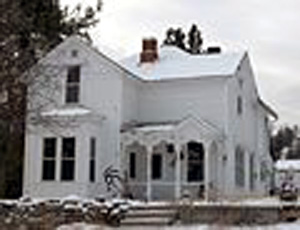 Wayne
shared this photo and remark, "This is a photo of the
Fairweather-Trevitt, aka "Bowlby," House, which, due to the efforts of
Sharon Bowlby Steuart, who spent her latter childhood years in this house,
and her friend and classmate, Madilane Perry-Bilderbach, was added to the
National Register of Historic Places in 2000 (Building Number 00000975).
Sharon's parents, Lee Warren Bowlby (14) and Wanda Louisene Lookinbee (originally
Lukenbill in Berne, Switzerland), lived in this house from around 1955
until 1999, when Wanda had to go to a nursing home. Lee had died
in 1996. Sharon sold the house in 2000. It is considered an
example of Late Victorian architecture and was built in 1902."
Wayne
shared this photo and remark, "This is a photo of the
Fairweather-Trevitt, aka "Bowlby," House, which, due to the efforts of
Sharon Bowlby Steuart, who spent her latter childhood years in this house,
and her friend and classmate, Madilane Perry-Bilderbach, was added to the
National Register of Historic Places in 2000 (Building Number 00000975).
Sharon's parents, Lee Warren Bowlby (14) and Wanda Louisene Lookinbee (originally
Lukenbill in Berne, Switzerland), lived in this house from around 1955
until 1999, when Wanda had to go to a nursing home. Lee had died
in 1996. Sharon sold the house in 2000. It is considered an
example of Late Victorian architecture and was built in 1902."
As I school boy I studied about the Oregon Trail, but
little did I realize then that a noteworthy Bowlby pioneer to the Pacific
Northwest and his family were among those who traveled the Oregon Trail
from the Midwest to Oregon. The family to which I refer was Wilson Bowlby,
M.D.(11)(1818-1895)[Samuel (8)]; his wife, Lydia B. Jones (1811-1883);
and at least the two oldest of their four children: John Quincy Adams Bowlby,
born 1843 in New York City, and Theodore F. Bowlby, born 1845 in Cincinnati,
OH. The couple later had two daughters, Sarah W. and Emily M. Dr. Bowlby
received his medical training at the Eclectic Institute of Medicine in
Cincinnati, OH and practiced medicine in Fairfield, IN for about seven
years before traveling with his family in a prarie schooner pulled by oxen
along the Oregon Trail in 1852.
In the spring of 1853, Dr. Bowlby purchased 320 acres
of land near Cornelius, west of Portland. He went on to not only practice
medicaine and own a drug store but to serve in the territorial legislature
and state legislature. Dr. Bowlby was buried at Forest View Memorial Gardens
in Forest Grove. His son, Theodore, and his wife, Sophia Adams, settled
in Cornelius and had ten children. To this day, many of their descendants
still live in that area of Oregon.
What and where was the Oregon Trail? It was not a single
trail but a series of trails from Independence, Westport, or St. Joseph,
MO to the Columbia River and the Willamette Valley of Oregon. The trail
was more than 2,000 miles long and required six months to traverse. Traveling
the Oregon Trail was a true test of the settlers' perseverance. They faced
both extreeme hot and cold weather; disease, particularly cholera; food
and water deprivation; and natural disasters, such as landslides, floods,
and prarie fires. Contrary to what some may think, encounters with Native
Americans on the Plains were rare, since the tribes realized the settlers
were simply passing through their homelands and were not intent upon establishing
homesteads. Earlier settlers of the Pacific Northwest came by ship from
the East Coast, around Cape Horn, and up the West Coast to the Columbia
River. That means of migration took a year to complete. The Oregon Trail
was most heavily used during the mid-1840's, but wagon trains continued
to use the trail for another ten years afterward. The Oregon Trail followed
the Snake River along the northern half of what today is Oregon's border
with Idaho, up into southeastern Washington State to around Pasco, and
then along the Columbia River to Fort Vancouver, the present-day Vancouver,
WA. The coming of the railroad ended the importance of the Oregon Trail
as a major route of westward migration by wagon train.
No history of the Pacific Northwest would be complete
without an account of the Lewis and Clark expedition of 1804-1806 and the
preceding Louisiana Purchase.
President Thomas Jefferson was concerned about France
and Spain being able to block import trade to the USA through New Orleans.
For $23,213,568, in 1803, the U.S. acquired 828,000 square miles of French
territory, which encompassed all or part of 15 present-day states and two
Canadian provinces, or 23 percent of the current continental United States.
The Louisiana Purchase subsequently sparked interest
in expansion all the way to the Pacific Ocean. Within weeks of the purchase
of the Louisiana Territory, President Jefferson asked Congress to appropriate
$2,500 for an expedition. He selected Captain Meriweather Lewis to lead
the expedition, which later became known as the Corps of Discovery. Captain
Lewis selected Second Lieutenant William Clark as his partner. On
May 14, 1804, the two men and their parties met and began the expedition
at Saint Charles, MO. Initially they followed the Missouri River northwestward.
During the winter of 1804-1805, they built Ford Mandan, near what today
is Washburn, ND.
At Fort Mandan, Lewis and Clark hired Toussaint Charbonneau,
a French-speaking fur trapper who was part Indian, as an interpreter. Charbonneau's
young Shoshone Indian wife was the famous Sacajawea, who, although not
an official member of the expedition, translated Shoshone to Hidatsa for
her husband and assisted in obtaining horses from her native tribe. On
February 11, 1805, Sacajawea gave birth to the couple's first child, Jean
Baptiste Charbonneau, whose presence proved to be an asset for the
expedition by dispelling fears on the part of Indian tribes which they
encountered that the expedition was a war party. Altogether, the expedition
members consisted of 40 men, Sacajawea, Jean Baptiste, and Captain Lewis'
large black Newfoundland dog, Seaman.
At the headwaters of the Missouri River, the expedition
proceeded over the Continental Divide by horseback and then by canoe along
the Clearwater River, the Snake River, and finally the Columbia River,
arriving at what today is Astoria, Oregon, near the mouth of the
Columbia River, by December 1805. There they built Fort Clatsop.
The explorers began their return trip on March 23, 1806 and reached St.
Louis, MO on September 23, 1806.
The Lewis and Clark expedition was the first American
expedition to the Pacific Northwest by land, but it was preceded by a Canadian
expedition in 1793, which was lead by explorer Sir Alexander Mackenzie.
The Canadian expedition constituted the first recorded transcontinental
crossing of North America north of Mexico by a non-indigenous person. However,
the Lewis and Clark expedition was followed by considerable westward migration
of American families to the Pacific Northwest, first by wagon trains on
the Oregon Trail and later by railroad. Among those migrating Americans
were Bowlby families, especially descendants of Samuel (8), John (8), and
Thomas (8), in that order.